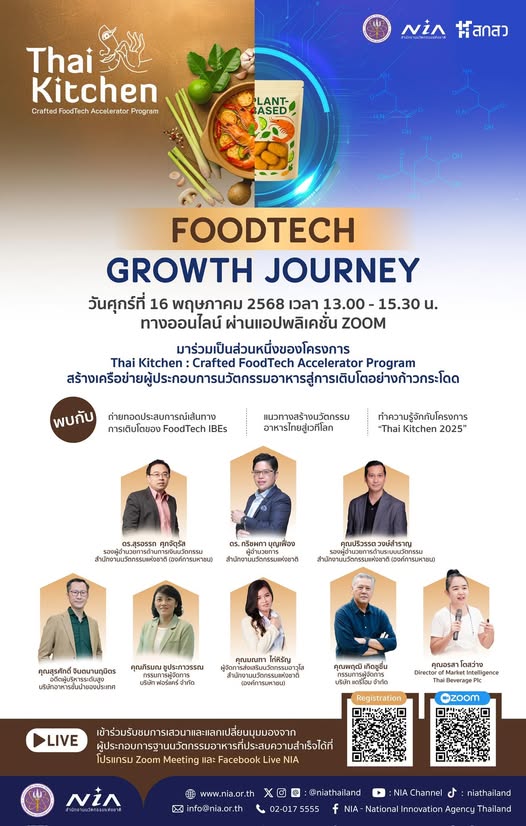
Driving the Thai food industry towards sustainable growth on the world stage through innovation is a mission the National Innovation Agency (Public Organization), or NIA, takes very seriously. “Thai Kitchen 2025” was created to answer exactly that challenge, setting out to transform the sector by accelerating innovation-based food-technology (FoodTech) entrepreneurs. The Open House held to launch the programme laid out a clear vision, a distinctive operating philosophy, and the strength of the ecosystem NIA has assembled to support Thai founders — all in service of one ultimate goal: to build competitiveness through innovation that meets the expectations of modern consumers, and to carry Thai food to lasting recognition and growth in global markets.
NIA’s vision and mission for Thai Kitchen
Dr. Krichpaka Bunyafueng , Director of the National Innovation Agency (Public Organization), said the Thai Kitchen 2025 Open House was staged to demonstrate how food-innovation businesses can be developed, and to prepare the ground for step-change growth through hands-on training and strategic matchmaking with leading experts. The approach aligns with Thailand’s potential to be the “Kitchen of the World” and builds on a Thai food industry that continues to expand, supporting the government’s Soft Power policy — with the industry’s total value in 2023 reaching some 4 trillion baht.
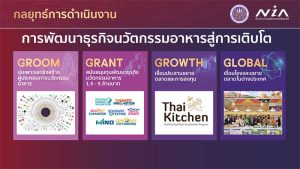
As the “Focal Conductor” — the connector and prime mover — NIA brings the parties together to promote food businesses through the agency’s four operating mechanisms: Groom (incubation and training), Grant (funding support), Growth (building the knowledge and business strategy the market demands), and Global (opening up opportunities in overseas markets).
Food technology, or FoodTech, is one of NIA’s target industries and is supported by the Thailand Science Research and Innovation Fund (TSRI) under its targeted programme for food-innovation businesses, with the aim of strengthening the competitiveness of the Thai food industry.
NIA intends Thai Kitchen to be a space, a platform and a common stage for incubating and supporting FoodTech entrepreneurs so they can grow — covering marketing support, strategic analysis, readiness for international markets, and tailor-made mentoring from leading experts in food, production technology, marketing, export, branding and digital communications with a combined reach of over one million followers. It also includes business matchmaking with buyers, investors and partner networks and, crucially, access to funding for innovation development, with the agency providing grants of up to 5 million baht.
This year the programme aims to take on ten revenue-generating Innovation-Based Enterprises (IBEs) in food that are ready to learn and expand into larger markets at home and abroad. All ten must be committed to developing products or services with genuine food-innovation potential in one of three categories: 1) high-value regional food, 2) high-value Thai food and fruits, and 3) Future Food. Thai Kitchen is therefore an accelerator — an incubation programme — that matters, because it pushes Thai food businesses onto the world stage through innovation.
Crafting Success
Dr. Suraat Suphajatturat , NIA Deputy Director for Economy and Society, spoke about the opportunities and challenges facing the Thai food industry. Thailand’s food exports are growing strongly — around 7% — but most of what the country ships abroad is still ordinary commodity food. That raises the question of how Thailand can increase the value of its food exports. There is only one answer, he argued: create food built on innovation.
NIA is concentrating its food-innovation work on several main fronts:
- Regional food: elevated through innovation — Thai regional dishes that keep their authentic, original taste even after export, while gaining value and keeping consumers connected to where the food comes from, whether that is Ang Thong, Phetchaburi or Chiang Mai.
- Premium Food: high-value, distinctive food that need not involve especially complex innovation, but must carry real value, distinctiveness and a premium character — well suited to export markets that are not yet ready for highly advanced food innovation.
- Extremely High Value food: novel foods, functional foods, and products driven by deep-tech innovation.
Dr. Suraat also explained what sets Thai Kitchen apart from the many incubators already operating. The answer lies in the philosophy of “Craft” — attending to, refining and developing each entrepreneur individually and with care, so that every business grows with its own identity and character. The programme was conceived as the “middle link” connecting founders who may already have been through other programmes, such as SpaceF or FoodInnopolis, but who still need more specific support. That is why Thai Kitchen exists: to “craft” Thai food entrepreneurs into something considerably stronger.
The programme targets businesses that already have traction — food innovation and sales in hand — but that are still unsure which direction to grow in. Thai Kitchen steps in with grooming and granting, and is the first NIA accelerator to deploy the full set of the agency’s mechanisms end to end: mentoring, funding, the push into the growth stage, and the route to global markets.
At its heart, Thai Kitchen builds a bespoke path for each of the ten participating businesses. No two journeys are the same: different mentors, different growth methods, different funding, different branding and different media. It is one-on-one crafting, which means participants need to be genuinely open so the NIA team can help and advise fully, and together find the best route to growth. Once that route is clear, funding support, rebranding and connections to real buyers and markets follow. The goal is a step change in value — a product that once sold for 10 baht per gram might command 1,000 or even 10,000 baht.
The power of the ecosystem: all-round support mechanisms for growth
Khun Pariwat Wongsumran , NIA Deputy Director for Innovation Systems, added that innovation is central to driving the economy, and that a company’s growth does not rest on capital alone — it also needs an ecosystem that makes growth possible. A grant on its own may not be enough; what matters is reshaping the business model so it can genuinely grow and scale, and seeking out partners and stakeholders within the ecosystem who can support one another.
NIA has been steadily developing Thailand’s innovation-promotion ecosystem in partnership with:
- Government: partner agencies such as NIA, DEPA, NSTDA and the BOI, which support entrepreneurs with knowledge, funding and access to incentives.
- Universities: the source of technology and R&D. NIA promotes “Open Innovation” and works with more than 50 universities, including university incubation programmes and the Regional Science Park network.
- Corporates: essential for going to market, particularly in B2B, where many companies want a corporate business partner to help them connect into — or build — a new supply chain. Several of Thailand’s largest food companies, among them Thai Union and ThaiBev, work with NIA to find new business frontiers (New S-Curve) and startups or SMEs whose solutions fit.
- Investors and financial institutions: for startups seeking investors or SMEs seeking loans, NIA offers innovation-promotion mechanisms including interest-free credit.
Thailand is well positioned in agriculture and food, with a very long supply chain, so NIA has built a collaborative network across the players in this ecosystem. Thai Kitchen draws on that ecosystem to analyse each company’s situation and respond to its particular needs — whether technology, funding or new markets — which is why the support is customised and tailor-made. NIA also has partners for overseas expansion, including the Middle East, with Saudi Arabia and Qatar standing out as markets of interest, as well as European partners for entering the EU market.
Khun Pariwat concluded that Thai Kitchen aims to develop entrepreneurs and companies that can genuinely grow, by understanding that each has different goals, and that the expectation is for all ten to scale into significantly wider markets — with innovation and the global market at the centre.
In short, Thai Kitchen 2025 brings NIA’s full weight to bear — a clear vision, a philosophy of “crafting” each entrepreneur individually, and the strength of a well-developed innovation ecosystem — to drive innovative Thai food businesses to step-change growth, added value, and sustainable competitiveness in global markets.